See a link here to a short film from the National Library of Scotland on some of the Arctic resources available in the library’s collection.
“A recorded online webinar on Scotland and the Arctic, presented by Curator Paula Williams. The far north holds a fascination for many, luring people towards the Pole for adventure and commerce. Situated on the main sea route to the north outside the Arctic Circle, Scotland has been a leaping-off point for explorers for centuries. But the dialogue flows both ways: the Arctic reaches out to us on our mountain tops and in our flora and fauna.”
Our events programme presents speakers who talk on a diverse variety of topics and often includes lively discussion with our live audience. The views contained in these event recordings are solely those of the speakers and audience at the event and do not necessarily reflect those of the National Library of Scotland.
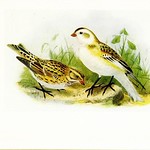
Illustration page showing Lapland Bunting (left) and Snow Bunting (right) Image: n341_w1150Birds of Britain London,A. and C. Black,1907.[etc.]1883-85. by Biodiversity Heritage Library. Public Domain at Flickr
May the 4th (#StarWars Day) 🙂 is usually a day for all things intergalatic but we also like to find about things nearer home, as well as those species that have a shared heritage across the northern regions.
At EalaCreative we are exploring how to work with archives and digital collections as resources for learning and creative inspiration. This image of two ‘bunting’ birds -Snow and Lapland – is from the Biodiversity Heritage Library available online. For some info on Scottish birds see for example the page posted here by The Scottish Ornithologists’ Club (SOC) on snow bunting sightings in Scotland.
In the Cairngorms – a mountainous tundra climate plateau region in Scotland – a number of ‘Arctic’ and -sub-Arctic species are found including the snow bunting. See here for more information on the Norsk Polarinsk resource site where you can listen to the song of the Snow Bunting, Svalbard’s only ‘songbird’.
“The snow bunting is the most northerly passerine bird in the world. It breeds in a circumpolar range, south to Scotland and Iceland, and it is a common breeder in suitable habitats in northern Scandinavia, Greenland, Svalbard, arctic parts of Russia and the northerly parts of North America.”
See also a like below for a Wildlife Photography video available on YouTube of Snow Bunting in the Cairngorms.
“904 views 6 May 2019 4th May Scottish highlands, a couple of days snow brought the Buntings down from the high tops of their breeding grounds, They are a scarce breeding species in the UK, in Scotland around 60 pairs, in winter numbers can be 12,000 birds up and the UK”. “Wildlife Photography Snow Buntings highlands of Scotland”. “
Tuonela – the realm of the dead – is the setting for the Kavela’s mythic hero Lemminkäinen‘s fate. Read more here about this famous Finnish tone poem by Sibelius The Swan of Tunela.
Tuonela. 1934 by Paul Landacre Born: Columbus, Ohio 1893 Died: Los Angeles, California 1963 wood engraving on paper sheet: 16 5/8 x 10 1/2 in. (42.2 x 26.8 cm) Smithsonian American Art Museum Museum Purchase 1982.95.1. “Tuonela” by americanartmuseum is licensed under CC BY-NC-ND 2.0.
You can read much more on this epic tale as the inspiration for Jean Sibelius, – Finland’s famous music composer – composition – the Lemminkäinen Suite – here.
The Kalevala – Finland’s national ‘story epic’ and work by artist Akseli Gallen-Kallela will be forever entwined.
You can read more about these links between ‘ancient stories’ and ‘modern times’ in an essay by Michael Hunt (2019), for the exhibition The Kalavala – In Other Words.
Elsewhere you can read more about “an alternative Kalavela” and research by Juha Pentikäinen, Professor of Modern Ethography at the University of Lapland. Juha Pentikäinen‘s research includes a focus on the deeper shamanic roots of the Kalavela’s folktales. See also here a discussion on the Kalavela’s philosophy, its story roots as ‘deep knowledge’ and links to folk healing.
“Tuonela is described as being at the northernmost part of the world but is sectioned apart from the world of the living by a great divide. In the divide flows the dark river of Tuonela. The river is wild, and the dead can be seen trying to swim across it. The dead must cross the river, either by a thread bridge, swimming, or taking a boat piloted by the daughter of Tuoni.[1] The river is guarded by a black swan that sings death spells.” Source https://en.wikipedia.org/wiki/Tuonela
The Finnish word for swan is joutsen. The word derives from jousi, the Finnish word for arrow.
Celtic Swans and Children of Lir in the Cairngorm National Park
Scottish and Irish mythology – a ‘Celtic mythology’ also features swans and here is a link to the famous Finnish story The Swan of Tuonela (and also a mention of the Irish story ‘The Children of Lir‘) as told by “The Irish in Finland”.
Finally, find a storytelling link here to the Scottish links to this folktale of the swan Children of Lir that includes a link to the history of Insh Church (the chapel of the swans) as told by Scottish musician Hamish Napier. The children turned to swans – as it is told here – flew between Ireland and Scotland for nine hundred years before eventually – on being turned back to their human form – they crumble to dust. Find some more information on Insh Church at the Am Baile Highland archive collections site. The church is near Loch Insh in Badenoch, located in the Cairngorm National Park in Scotland’s highlands. Nearby to the church is Insh Marshes a national nature reserve rich with ecology and wildlife as”one of the most important wetland areas in Europe”.
Welcome to the EALA project ‘blog post’ page. Some of our explorations and OER resources based around our EALA project learning are shared here with links to available materials and downloads. This is a learning space for the EALA team and so we may look to revise, amand and improved our materials and OER elements – learning as we go – so you may see some things (posts, images and other materials) change over time!
Why EALA ? – Our EALA project has taken its title – and its logo – from the swan. The swan represents Finland’s national bird and our University of Lapland partner as well as the symbolic connection the swan holds in many cultures of ‘the North’ as symbolic of mythical creatures, transformation, and other worlds, not least here in Scotland. In the Gaelic language of Scotland the word for swan is eala. As part of the original idea for the project we wished to select an image that represented ideas of partnership, connection, mobility and the migration of knowledge and understanding. We also wanted to celebrate the ecocultures of place while we explored our Arctic and near Arctic contexts. The UWS (University of the West of Scotland) Ayr Campus is located on the River Ayr and we see swans regularly in the rivers, coasts and lochs nearby. One of the EALA participants is international student Bingrui Sui studying MA Creative Media Practice at UWS who worked to develop our original first draft design to the final EALA logo you can see above. You can read about Bingrui’s reflection on the creation of this resource here.
This EALA learning exchange project (2022-2023) explored Scotland’s links to the Arctic through an OER focus for learning and creativity exchange. OER – open education resource – is a process and ambition to create, curate and circulate materials and artifacts such as images, texts and documents for wider access and sharing. EALA as a title also offers us a simple summary of the project’s frame of reference: Engagement, Alliance and Learning for Arts. Please click on the menu for more information and we look forward to sharing our artefacts and reflections with you.



 EalaCreative