Put the flags out! Finding Bunting!

n341_w1150
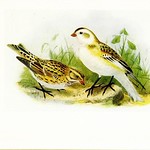
Illustration page showing Lapland Bunting (left) and Snow Bunting (right)
Image: n341_w1150 Birds of Britain
London,A. and C. Black,1907.[etc.]1883-85. by Biodiversity Heritage Library.
Public Domain at Flickr

May the 4th (#StarWars Day) 🙂 is usually a day for all things intergalatic but we also like to find about things nearer home, as well as those species that have a shared heritage across the northern regions.

At EalaCreative we are exploring how to work with archives and digital collections as resources for learning and creative inspiration. This image of two ‘bunting’ birds -Snow and Lapland – is from the Biodiversity Heritage Library available online. For some info on Scottish birds see for example the page posted here by The Scottish Ornithologists’ Club (SOC) on snow bunting sightings in Scotland.

In the Cairngorms – a mountainous tundra climate plateau region in Scotland – a number of ‘Arctic’ and -sub-Arctic species are found including the snow bunting. See here for more information on the Norsk Polarinsk resource site where you can listen to the song of the Snow Bunting, Svalbard’s only ‘songbird’.

“The snow bunting is the most northerly passerine bird in the world. It breeds in a circumpolar range, south to Scotland and Iceland, and it is a common breeder in suitable habitats in northern Scandinavia, Greenland, Svalbard, arctic parts of Russia and the northerly parts of North America.”

See also a like below for a Wildlife Photography video available on YouTube of Snow Bunting in the Cairngorms.

904 views 6 May 2019 4th May Scottish highlands, a couple of days snow brought the Buntings down from the high tops of their breeding grounds, They are a scarce breeding species in the UK, in Scotland around 60 pairs, in winter numbers can be 12,000 birds up and the UK”. “Wildlife Photography Snow Buntings highlands of Scotland”.

Looking West – Looking North

The EALA project is a OER connections project based at the University of the West of Scotland (UWS) and working in creative practice and arts pedagogy partnership with the University of Lapland. The EALA project was funded by the Scottish Government’s Arctic Connections Fund 2022-2023 to explore and expand Scottish and Arctic creative contexts and commons.

EalaCreative – the working group of participants – have used the symbol of the swan – jousten (finnish); eala (scots gaelic) – as a theme for our cultural, environmental and socio-ecological pedegogy focus.

In Finland the swan holds a very special symbolism for the nation and this Tuonela swan myth is explored by the EALA creative project team here.

The swan.
Image of ‘Northern Lights’ titled “The Swan” by Béatrice Karjalainen (CC BY-NC-ND 2.0) at Flickr

We have looked west, south and east in our focus on looking north! This post speaks a little more to looking west and the islands of the Outer and Inner Hebrides.

Mute Swans in Flight
Mute Swans in Flight by Caroline Legg (CC-BY-2.0) at Flickr

Energy “at the margins” – powercuts! Across the islands of Scotland’s west swans (most usually Mute Swans) are often seen flying high overhead as they migrate but so too they might fly low and occasionally power would be lost (“powercut“) as they might fly into the electricity cables that hung from the wooden poles across the islands’ moorland. In Uist in the Hebrides to the west of Scotland, for example, it might occasionally happen that a “downed” swan might be found dazed and slightly disorientated in the narrow water course channels of the intricate loch and peatland bogs and the land drainage systems. Having hit the wire the swan might rest and recover in these low lying bogs and ditches.

Elsewhere across the cultural history of Scotland and other landscapes and nations the swan is a symbol of life long partnership. Images of swans paired together consumed with their ritual return nesting habitats are common across digital resources and informed our EALA logo design.

Archives and Wildlife Science

In exploring the open accessible resources available online (creative commons) for images of swans at South Uist at Loch Bee we discovered the work of Dr Mary Gillham, a wildlife scientist. An archive project offers her collection of photographs for others to view and re-use and includes many images taken in Scotland, but also in regions such as Antartica:

“Dr Mary Gillham MBE (1921 – 2013) was a pioneering naturalist and prolific wildlife author, who took an active interest in the environment for over 80 years. In 1959 Mary was a member of the first Antarctic expedition to include women scientists,” Dr Mary Gillham Archive Project

Below is just one image from Dr Gillingham’s archive – an image of Loch Bee on South Uist, Outer Hebrides. Although rather difficult to see the swans in the distance (small white dots on the dark blue water) the image offers a sense of the area’s assets low lying natural ecology of the loch, alongside its working landscape that includes crofting (cattle are seen grazing), estate management (loch fishing), and the ‘open skies’ of the islands north Atlantic ‘periphery’ situation for the nearby defence missile testing site (the”rocket range”) Range Hebrides. A view of a rusting oil drum can be seen lying in the peat moorland bog in the foreground.

Mute swans over west half of Loch Bee (Bi) South Uist
Image : Mute swans over west half of Loch Bee (Bi) South Uist, South Uist Moor. MT (Outer Hebrides Scotland). Courtesy of Dr Mary Gilliham Archive Project (CC-BY-2.0) at Flickr.