See a link here to a short film from the National Library of Scotland on some of the Arctic resources available in the library’s collection.
“A recorded online webinar on Scotland and the Arctic, presented by Curator Paula Williams. The far north holds a fascination for many, luring people towards the Pole for adventure and commerce. Situated on the main sea route to the north outside the Arctic Circle, Scotland has been a leaping-off point for explorers for centuries. But the dialogue flows both ways: the Arctic reaches out to us on our mountain tops and in our flora and fauna.”
Our events programme presents speakers who talk on a diverse variety of topics and often includes lively discussion with our live audience. The views contained in these event recordings are solely those of the speakers and audience at the event and do not necessarily reflect those of the National Library of Scotland.
Image credit : Shetland Arts (CC-BY-ND-2.0) at Flickr Timo Jokela exhibition, Feb 2010 – schools workshop the gallery – Lunnasting II
“Today, the Arctic is developing into an important hub of the twenty-first century; industrially, socially and politically. We believe that the economic potential of the region should be harnessed in a way that brings prosperity and guarantees the livelihood and social-cultural progress of Arctic inhabitants and communities.”
At our EALA Project sharing site we aim to connect and create materials and resources for a focus on ‘north’ art and design for sustainability and connections between Scotland and the Arctic. What is North – as Jokela and Coutts (2018) have detailed below – can and does include regions that are experienced ‘as north’, as well as northern parts of countries. We are especially keen to direct interested readers and creative content makers to the UArctic ASAD thematic network resources available for research and learning. Editors of the Relate North series Timo Jokela and Glen Coutts talk below of the importance of testing and developing new art and design methodologies via the UArctic ASAD network, and other key art education connections including InSEA (see the recently published RelateNorth #9DOI: 10.24981/2022-RN#9).
“… we explore the notion of the North1 and the Arctic as a ‘laboratory’ of art and design education for sustainability. The chapter is organised in three sections, the first is a discussion of the idea of northern conditions as an environment for testing and developing new art and design methodologies. In particular, we are interested in how art might address the effects of rapid changes in the social, cultural and economic setting and post-colonial situation of the area.”
When we refer to the North we mean the northern part of the world on the northern hemisphere or northern parts of specifc countries, for example northern Canada, Scandinavian and Nordic countries and countries around the Circumpolar North and regions rather than simply the direction in which a compass normally points.
Image credit Shetland Arts (CC-BY-ND.2.0) at Flickr Timo Jokela @ Bonhoga Gallery, Weisdale Mill, Shetland. 13 Feb – 7 March 2010.
Sharing platforms such as Flickr creative commons offer digital facilities for individuals and organisations to upload and share their images and content for wider re-use based on various ‘Creative Commons’ licence conditions. Examples can include images taken of places, events -such as this image above by Shetland Arts – or artefacts and can include images shared by both professional and amateur photographers, as well as researchers, archivists, policy champions and many others in many roles. You can read more about Flickr here.
Arctic Nature in Lapland, Finland by Niara (CC-BY-2.0) at Flickr Utsjoki to Rovaniemi There are bogs, forests, lakes, rivers, rocks, fells, fields, water in Finnish Lapland. The photo was taken from the bus. Some of these photos are taken from the bus between Utsjoki and Rovaniemi.
Nest of a Whooper Swan (Cygnus cygnus) (image “n106_w1150“) by BioDivLibrary is licensed under Public Domain Mark 1.0 at Flickr.
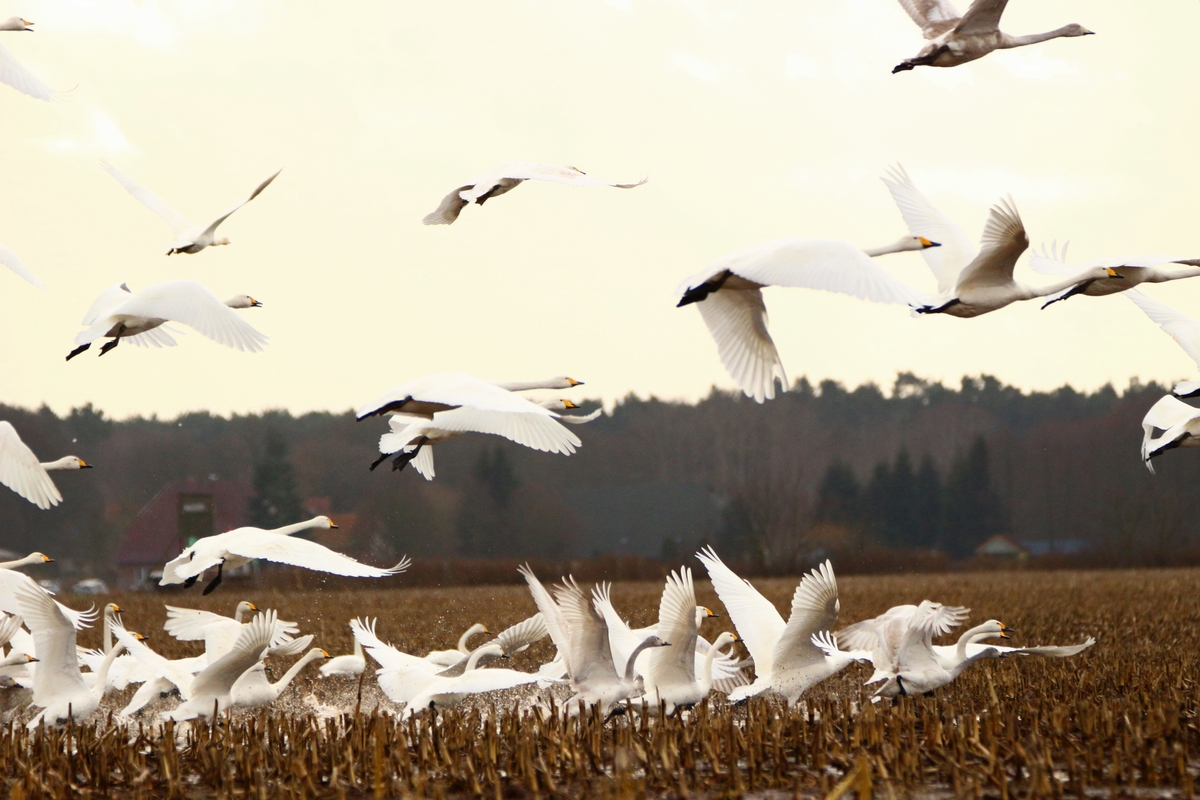
EALA has taken the swan as its motif. The EALA participants explored a number of resources related to swans, and other birds in both Scotland and the Arctic using online resources and digital repositories of images. This image of a nest of a Whooper Swan is from a collection of images held by the Biodiversity Hertiage Library from the book by R.H. Porter (1904) Three summers among the birds of Russian Lapland, London. Source: biodiversitylibrary.org/page/40161711
“Ever since its establishment, environmental protection has been at the core of the work of the Arctic Council. In the Council’s founding document, the Ottawa Declaration, the eight Arctic States affirmed their commitment to protect the Arctic environment and healthy ecosystems, to maintain Arctic biodiversity, to conserve and enable sustainable use of natural resources. It does so through defined actions based on scientific recommendations.”
“Our work contributes to the Scottish Government’s purpose of “creating a more successful country, with opportunities for all of Scotland to flourish, through increasing sustainable economic growth.” NatureScot
Scotland’s natural capital plays an important role in:
supporting economic growth
improving health and well-being
reducing greenhouse gas emissions and helping us to adapt to climate change
strengthening communities
Photo: Wildlife and biodiversity by Scottish Rural Network (CC-BY-SA-2.0) at Flickr Image detail: The image relates to Wildlife and biodiversity Discussion theme at the Scottish National Rural Network regional event in Orkney. The event took place on 28th May 2010 at the St Magnus Centre in Kirkwall. You can find out more about the Rural Network at www.ruralgateway.org.uk.




 EalaCreative