


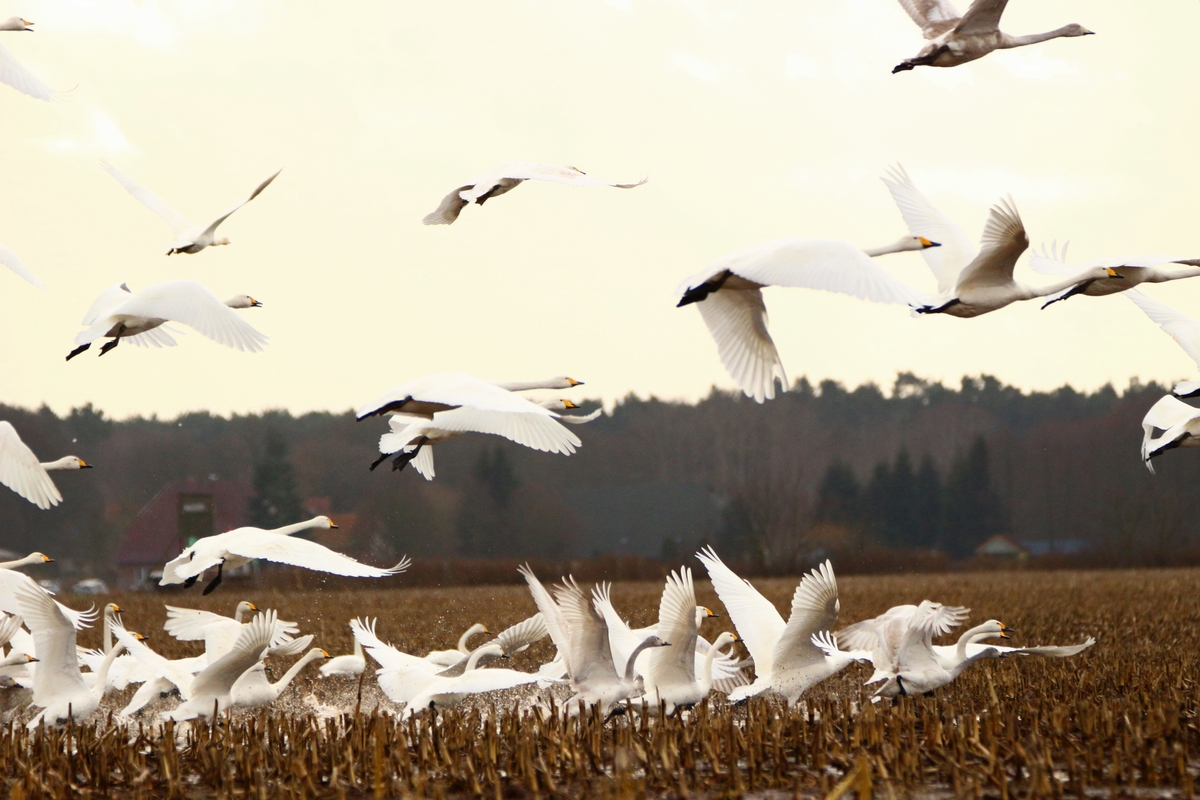
The image above of swans flying over Loch Insh is by the photographer Charlie Marshall. The EalaCreative team selected this striking image as representative not just of the swans who migrate to and from Scotland and circumpolar regions but also in this case, as the photograph is from Loch Insh, to connect here to a particularly special place and landscape – the Cairngorm mountain region in north-east Scotland. This mountainous area, with forests including large tracts of Scotland’s ancient Caledonian woodland, and freshwater lochs of snowmelt, is notable as being an area of mountain plateau of alpine and tundra like climate and ecology, a unique landscape in the whole of the British Isles.
“The Cairngorms provide a unique alpine semi-tundra moorland habitat, home to many rare plants, birds and animals. Speciality bird species on the plateaux include breeding ptarmigan, dotterel, snow bunting, golden eagle, ring ouzel and red grouse,[6] with snowy owl, twite, purple sandpiper and Lapland bunting seen on occasion.[40] Mammal species include red deer and mountain hare,[6] as well as the only herd of reindeer in the British Isles. They now roam the high Cairngorms, after being reintroduced in 1952 by a Swedish herdsman. The herd is now stable at around 150 individuals, some born in Scotland and some introduced from Sweden; since the individuals depend on humans for food and come from domesticated stock, they are not considered wild.[7]
https://en.wikipedia.org/wiki/Cairngorms
The Cairngorm area is named after one of its main mountain peaks Cairn Gorm and the wider area most espcially in leisure and tourism terms is more often referred to as ‘The Cairgorms’. The region is now a designated national park (Scotland’s second) and is a Site of Special Scientific Interest (SSSI). More information on this can be found here NatureScot and a detailed summary of this Cairgorms SSSI can be downloaded from the NatureScot site, including the vegetation of alpine moss-heath, sedge and rush vegetation ‘communities’:
“The Cairngorms has the largest tracts in Britain of a range of alpine moss-heath and associated sedge and rush communities developed on base-poor granites and schists and the full range of these communities. The community characterised by three-leaved rush is
Source: NatureScot, CAIRNGORMS SITE OF SPECIAL SCIENTIFIC INTEREST Highland, Moray, Aberdeenshire
particularly well developed, with the full range of subtypes varying from those where woolly fringe-moss Racomitrium lanuginosum is co-dominant to open tussocky, lichen-rich areas.
Extensive areas of the plateau are dominated by stiff sedge Carex bigellowii and woolly hairmoss, particularly on the western spurs and ridges.”


 EalaCreative